Thursday, April 17, 2008

A Gilded Glory


That title sucked.
But this game didn't. In a market where I thought RPGs were getting run into the ground with similar story elements and hackneyed mechanics, I found this beauty on the GBA.
Golden Sun is a unique game in its approach, handling, story -- well, anything, although the equipment system could be likened to other RPGs (I'll knife anyone who says the Djinn system is anything like Materia, though).
The land of Weyard once experienced a golden age of Alchemy -- that is, the power of the elements -- in which civilizations grew to incredible heights of achievement (amazing, an RPG that actually gives reasons for the existence of its ruins). However, the power of Alchemy lead to world conflict that eventually caused the desire to seal the power away to avoid its corruption. The powers of Alchemy (and in subsequent explanations, Psynergy) are divided into four elements represented through the game by Earth [Venus], Fire [Mars], Wind [Jupiter], and Water [Mercury]. I'm not quite sure why the chose those particular names for each element, but it seems to work for poetic effect. The power of Alchemy is harnessed by "adepts" of the given element, in the form of Psynergy -- essentially, magic in this game. The keys to Alchemy are 4 jewels each representing an aforementioned element, locking away the wellsprings of Alchemic power in the four elemental Lighthouses that the ancient cultures constructed throughout the world to house the power.
These jewels, the Elemental Stars (Mars Star, Jupiter Star, etc) are where our heroes enter the game. The jewels were hidden in Mt. Aleph, a mountain shrine that sits atop the town of Vale, which has been charged with protecting the jewels from those that would seek to unlock Alchemy again. Two of the main characters, Isaac and Garet, and a more minor story character in Jenna, hail from the village of Vale, along with the scholar Kraden. In the prologue, the village is attacked by two of the Mars tribe named Saturos and Menardi, in order to steal the elemental stars; however they failed to solve the puzzles of Mt. Aleph and were forced to flee. At the beginning of the game proper, they have returned with two accomplices -- one of which happens to be a former resident of Vale and Jenna's brother. Thus the plot thickens as Saturos and Menardi force you to hand over 3 of the 4 elemental stars before escaping the now pissed off Mt. Aleph with Jenna and Kraden as hostages to ensure you bring the fourth star to them.
The basic premise of the game is to travel to the lighthouses and stop them from being lit with the stars (thus freeing Alchemy once more, considered to be catastrophic now), and along the way you run into various problems in each town. They aren't quite as distracting as side quests and exposition usually are, and often give more background into the world. Along the way you meet your other party members, a Jupiter adept named Ivan and a Mercury adept named Mia, giving you a nice, well-rounded group.
The "gimmicks" of this game include the Psynergy you use to do damage in battle, heal, and solve puzzles with. The puzzle-solving aspect is the most interesting -- as you progress, you gain different psynergies that can open up other paths. For example, you initially start with "Move", which is just as it sounds. It extends a psycho-kinetic force that moves an object one space at a time. Further down the road you get other spells such as Force to knock down broken things or Frost to freeze puddles of water into pillars you can then hop on top of or push to switches. It's probably not -completely- innovative, but it feels new and fresh and adds a good spin on a genre that, admittedly, was feeling stale at the time. The other gimmick is the Djinn system. You have to collect little spirits of each element (the Djinn themselves), sometimes having to solve puzzles or battle them before they will join you. They can then be unleashed in battle after equipping them to yourself, causing various effects (critical attack, defense up, etcetera). After they've been unleashed, they can then be used to summon powerful creatures, but you lose the buffing to your stats without the Djinn equipped. After a summon, the djinn need to recharge and will automatically reequip themselves after recharging, forming a rather well-crafted battle flow. A third gimmick is weapon unleashing, which occurs with rare equipment -- essentially, it's a critical hit with added effects and nice visuals, such as lowering enemy's attack or causing paralysis.
Another interesting part is the artifact system, in which you find or are able to buy valuable strong equipment. Should you sell them, you can buy them again at a raised price from any weapon or armor dealer in the world.
The difficulty curve jumps around a lot throughout the game, but it's at understandable intervals. The dungeons (like the Lighthouses) are long, but feel like you're accomplishing stuff along the way.
However, when you reach the end, you'll be wondering "what, that's it?" The game itself seems unfinished, but it leads to an incredible sequel that juxtaposes everything you learn in this game. Essentially, each game is half of the full story, and the writers at Camelot showed incredible vision in how they planned out everything that occurred in both games.
The only major complaint I could have would be the nonbattle artwork. The 3D rendered models are cute, but I think it could have been more successful as 2D sprites. The 3D effect makes characters and enemies look pixelated and choppy, whereas a much smoother effect could be more effectively utilized with 2D. Although, since the world itself is rendered in isometric 3D, it does work reasonably well.
All in all, this game is an amazing RPG that I was happy to see featured in SSBB, although I wish they had made one of the heroes of the series a character instead of an assist trophy. This series is a gem for the GBA, and a favorite of mine on par with many Final Fantasy games with longer stories and better graphics. I think that really speaks to Camelot's ability as creators. Unfortunately, the series seemed to have a great deal of closure at the end of the second game, which leads me to believe there's little chance of a third Golden Sun.

Regardless, give the series a try. If you like RPGs with a puzzle twist, you won't be dissapointed.

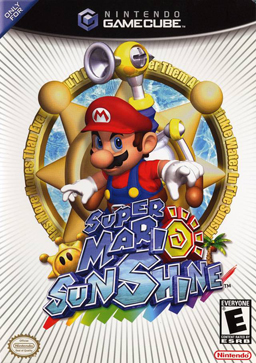
A Soggy Interlude


I realize I've been doing a lot of games that I like, but now it's time for something I don't like but played anyway like the masochistic bastard I am. (Am I channeling Yahtzee here?)

I'm talking, of course, about Super Mario Sunshine for the Gamecube. In theory, this game should have been great, as it was treading the same launch title Mario game path as Mario 64 -- unfortunately, it does not tread the path. It stumbles, cries, and wets itself.
The game looks very pretty and boasts great water physics for it's time, but why the hell would you bastardize the series by giving Mario a squirt gun? It was an innovative idea, but the best part of the game was when they took its gimmick away and made you do platforming. You know, the thing Mario games are supposed to be. They were excruciatingly hard at some points, but in a good, challenging kind of way, instead of the simpering preschooler sort of way that the rest of the game is.
The story is convoluted far beyond what a non-RPG Mario game requires, with a "shadow Mario" that frames you for polluting the sunny pianta capital of Delfino Island with wierd goop that sometimes resembles what Mario should clean up if he were doing what his real job was instead of rescuing a blonde with ADHD and stockholm syndrome. It gets even more bizarre by insinuating a lovechild between Peach and Bowser, who doesn't even show up beyond mechanical likenesses till exceptionally late in the game, leaving you wondering just who the hell you're up against and wandering around from point A to point phi.
It was a bad gimmick in the time when Nintendo was pushing the envelope by changing their star characters' games around so much, but it doesn't hold a candle to its peers of the age like Metroid Prime or Zelda: Wind Waker, or even Star Fox Adventures or Kirby's Air Ride. It's certainly not the second coming of Mario 64, simply because they tried to do something dumb with something that didn't need tweaking to be great and sell.
What's worse is that it's legacy continues as possibly the most useless Down-B move in Super Smash Brothers Brawl.

Sunday, April 6, 2008

A gem from the past


Haven't been keeping up with this very well, so progressively this week, I'm going to try to ante up and make up for the lost time.

Tonight I bring you the tale of a game that experienced little love, a treasure by Treasure during the somewhat lackluster years of post-launch Nintendo 64. I speak of Mischief Makers, a the faux-3D 2-D side-scrolling platform gem buried amongst the burgeoning 3-D market.
This game tells the story of Professor Theo and his robotic maid, Ultra-Intergalactic-Cybot G Marina Liteyears during their visit to the planet Clancer. During their stay, the professor is kidnapped in a very Princess Peach-like fashion, whisked away by the evil empire ruling the planet Clancer. It's up to Marina to save her creator, and she does so with a rather unorthodox style of gameplay in a bizarre world where everything has a similar face.
The side-scrolling adventure's actions revolve mostly around Marina's grabbing move, after which she can shake, toss, or use objects. Objects shaken can activate other effects or shake loose Crystals or other items. Marina can use her jetpack to double-jump or jet sideways to avoid enemies, but mostly you'll want to be grabbing and tossing your foes as much as possible. Not every enemy is as easily defeated as that, and some levels and bosses can require fast reflexes, especially if you desire the Gold Gem that exists in every level.
The whimsy of this game comes in it's simplistic but frantic play style along with it's bizarre world and graphics. There are few shortcomings that come to mind -- the difficulty is adequately challenging, and each level offers a different type of obstacle or puzzle for you to overcome. If anything, the only complaint I'd have is that it does not have any sort of sequel or remake yet. If I could, I'd petition Nintendo to put this little gem on the Virtual Console.

Monday, February 11, 2008

Tim Schafer is my hero (Psychonauts)


I know Tim's worked on many other games, including the infamous Grim Fandango and some of the Monkey Island games, but I think his talent truly shined in his more recent creation for Playstation 2.

Of course, I'm referring to Psychonauts. I played this game a while back, but it's too good to pass up plugging here. The platforming genre felt like it was getting stale till I picked up this gem, with Super Mario Sunshine being a super let-down and Sly 3 apparently ending one of my favorite espionage-slash-playful playformer series. Granted, by that time Psychonauts had aged a bit compared to some of the other games in my PS2 library, but when I started playing it, I almost couldn't put it down till the end. A platformer hasn't kept me that enthralled since Super Mario World (with Sly 2 being a close second).
The gameplay mechanics are relatively good, and the ingenious way they implemented Razputin's various psychic tools was interesting to see play out in the actual mechanics of the game. However, I believe the strongest points of the game are the character designs and even moreso the level designs. You would expect that visiting the interior of people's minds would be a pretty surreal experience, and Mr. Schafer does NOT disappoint in this respect. Every level is a treat for the eyes and a euphoric explosion for the psychadelic side of your psyche: Coach Oliander's war-torn mind, Agent Nein's organized brain, Mia's perpetual party, Edgar's black velvet and neon Madrid (particularly beautiful level), and especially Boyd's paranoia-induced twisted neighborhood in The Milkman Conspiracy. The art of the game is unique and just as warped as the game itself, which only adds to the whole motif of the bent nature of the human mind.
The whole premise of the game screams epic, in that you're a camper at a summer camp for gifted children with psychic abilities. The slightly bent humor of the game makes itself apparent mostly in your fellow campers, including one who must wear an aluminum hat to keep the "voices" out, and constantly has to avoid the influence of the evil squirrels that inhabit the camp and chuckle maniacally when you walk past. Once you get the appropriate badges (certification for psychic abilities), you can blow the little bastards up yourself. The most fun powers to use are likely Levitation (which takes the form of a "thought bubble" you roll around on top of and float from) and Pyrokinesis, which lets you make things spontaneously combust, explode, and damage other things around that object (effectively turning your enemies into bombs). Powers are upgraded as your collect your Psychonaut rankings.
The one downside I see right now is that it doesn't appear that there's going to be a sequel, as badly as this game needs one. If anything, the game feels a bit too short. Like this blog entry.

Fun fact: This game is NOW backwards compatible with XBox 360, is available in PC format and PS2, Xbox, and also on Gametap. Go try it now. You won't be disappointed.

later!

Saturday, February 2, 2008

Of Raccoons and Priests


This week it's a blast from the near past. A fairly rare game for the Super Nintendo, Pocky and Rocky wasn't exactly The Legend of Zelda: A Link to the Past, but it took an arcade twist to an easy-to-follow adventure set in a mystical alternate Japanese past.
This game is steeped in Japanese folklore and mythology, so the creatures probably seem very weird to those of us on the other side of the Pacific. You play as one of two beings: Pocky, a young female priest who fights with a charm and throws talismans, and Rocky, a tanuki (raccoon dog) that fights using its tail and throws magic leaves. There's really not much beyond aesthetics between which character you pick. The game plays more similarly to Galaga or Ikaruga, or some space shooter like that, in that enemies constantly stream from the top or side within an given instance of an area -- areas are divided into screens, and each screen has a certain amount of enemies along its path. Power-ups come in the form of mystic talismans, which power up your throwing items to new levels (either a multi-spray or larger thrown items), and if enemies get too close to shoot, Pocky and Rocky can repel them with their charm or tail respectively.
The cutesy nature of this game can be deceptive, as it sometimes requires some twitch reflexes. The controls are pretty responsive, but the enemy movement patterns can be hard to hit, and bosses can take a while to wear down. It doesn't feel quite as mindless as the game I previously blogged about. I enjoy the simplistic yet still slightly challenging nature of the game, and the distinctly Japanese flair of the game reminds me of another old favorite, Legend of the Mystical Ninja. The graphics are neither good nor bad, being a SNES game. Just be prepared for some odd enemies.
It's good for a rom or to own, and I recommend playing through it at least once.

Monday, January 28, 2008

Children of Nada


I picked up Children of Mana for the DS recently.


And I wish I hadn't. I didn't think that Square-Enix could completely screw up a good premise for such a good franchise, but hey, they did create FFX-2 and Drakengard.
The plot seems structurally sound, with a damsel in distress and underlying lore -- though it is not as involved as Seiken Densetsu 3. The atrocious part, however, is in the gameplay factor. The randomly created dungeons with waves of mindless AI enemies, and a character who starts out and stays fairly weak and ineffectual throughout the game, since enemies scale with your character to make him/her/it feel even more inadequate. You only get one Elemental Spirit, which means only a few different spells, and since only 2 of them can do anything remotely resembling healing, you're usually stuck relying on the light or lunar spirit. It's definitely a dungeon crawler, but I played many with much better, more interesting dungeons and exceptionally more interesting fights. Progression through areas of a dungeon probably seemed like a good idea in theory, but finding the Gleamdrop (the key to go to the next part of the dungeon) quickly becomes a tedious chore.
The one saving grace of this might be the mission system, which at least rewards you for returning to previously completed dungeons and trudging through the same puzzles that exist in every other map of every other game. The other moderately refreshing thing is the use of different weapon types (sword, flail, bow, and hammer). However, the upgrades to these come far more frequently than your wallet can usually buy, which forces you to inevitably do more town missions.
One of the more interesting effects is the uses of the spirits; releasing the elemental spirit with you will have it float nearby. If you leave it alone, it will unleash a damaging spell, with areas of effect being different for each one. The casting time is so long and the effect fairly weak, however, and more often than not it is just far more efficient to rely on your own weapon. If you touch it, you activate another spell/effect, usually healing or enchanting your weapon with the spirit's element. The spirits themselves can be raised to higher levels and attain stronger magic with the equipping of Gems, which players find in dungeons or buy from town. Again, however, your wallet and needs will limit what gems you can or should use, and many good ones seem to come with detrimental effects as well.
All in all, the game turned out to be a really boring hack-and-slash dungeon crawler. It's a poor excuse for a Mana game, especially when compared to the original Secret of Mana, Seiken Densetsu 3, and Legend of Mana. I would really have much rather seen a translated port of SD3 than this atrocity.

Tuesday, January 15, 2008

Extending the Neverending


Hopefully this will count for the assignment. Even if it doesn't, I've been wanting to put in my two cents on this one anyway.

I've been playing Final Fantasy XI off and on for a long time, usually moving over to World of Warcraft when I get tired of the utter lack of independence in FFXI; you need at least five other people to do the most mundane of tasks, barring tradeskills, unless you're a masochist who has completely leveled up Ninja (biggest money sink in the whole game, in my opinion).

So I was a little skeptical when I picked up the latest expansion -- Final Fantasy: Wings of the Goddess is the third expansion (fourth for Japanese players) for this love-it-or-hate-it MMO. Wings of the Goddess (WotG for future reference) gives the players the opportunity to travel into the past and experience the Crystal War in which the Beastmen hordes banded together under the Shadow Lord to crush the fledgling nations of Windurst and Bastok, as well as the kingdom of San d'Oria.
The way that players return to the past is through strange Cavernous Maws stationed around the world in various locations (only in original zones). People who played Final Fantasy 9 might recognize the resemblance between these maws and a particularly fun summon beast, though that isn't the first time they've used the gaping demon mouth things.
WotG introduced a few new aspects to the game, including a new battle system called Campaign and the accompanying medal system that gives players benefits as they aid the forces of Altana (the armies of Windurst, Bastok, and San d'Oria). Campaign battles take place in the outdoor maps all around the world of the Past, and can occur at any time. It is comprised of waves of monsters attacking the Fortification of the zone, and the army of non-player characters (NPCs) with the aid of players fighting them off. To participate, you talk to a Campaign Arbiter at the fortification, who gives you a special buff that will let you accrue Allied Notes ("currency" for purchasing equipment or items from the armies) as well as experience points, which are given at the end of the campaign battle. This allows a slow, but reliable way to gain experience points that does not require a party of five other people, and anyone can participate at any level assuming you can get to the past. However, the amount of experience and Allied Notes is based on your performance during the battle -- if you're just standing around or not able to contribute a lot, your campaign assessment will suffer.
Aside from and intertwining with the story of the Crystal War, Wings of the Goddess introduces a new storyline to explain the temporal rifts (the aforementioned Cavernous Maws) and brings in a few familiar names from the Final Fantasy series with fairly drastic makeovers. The expansion also introduced two new playable classes, Dancer and Scholar -- both of which, at first, seemed greatly out of place in the clear-cut job distinctions of FFXI (support, tank, mage, healer). Previous experiments in mixing and matching party dynamics are still lacking (Summoner, Puppetmaster), yet it seems they hit the mark with these. Dancer, despite the initial dismay at prancing around on the screen, is probably the most entertaining class I've ever played in the game. It is the only job capable of healing without the use of magic, and is good blend of support and damage -- it can even tank in smaller parties, though lacks the lasting strength and holding power of Paladins or Ninjas. Scholar, on the other hand, feels like a rehash of old magic that we've gotten used to over the years with a twist of being able to augment mana cost, cast times, cast delays, and possessing the capability to heal very effectively while still having only a slightly lower magic damage potential than Black Mages. The fact that both of these jobs make incredible subjobs as well as main jobs (though Scholar is lacking in defensive capability) is a testament to the careful attention the development crew has taken.

To be honest, though, I wish I had not bought the expansion before the first version update for it. It may seem like there's a lot to do at first, but it quickly runs dry as the story halts at the third mission. Campaign and the new jobs are greatly entertaining, but for someone who likes continuing storylines like I do, not being able to progress is frustrating. All in all though, it's shaping up to be a good expansion, with a few much needed additions to the game play. New jobs always offer a fresh start, and it's exciting to experiment with them and explore the expanded world. It just needed more content on launch. On this subject I can't help but compare it to the only World of Warcraft expansion, The Burning Crusade -- there was a VAST amount of new subject matter to explore, levels to gain, skills to experiment with, and it did what an expansion should do: completely revolutionize the game and make it feel fresh. It even continued the warcraft lore, which was already rich from the RTS games. FFXI expansions, however, are encapsulated with their own storylines, which are admittedly interesting, but the lack of connections between them make the whole game seem fractured into segments rather than a continuous journey.

Running out of steam for this post, but I'll provide updates as they come along in my next few posts.

Treble - 75 Bard, 75 Black Mage - Caitsith Server